

How Much Does It Cost to Build a Mobile App in 2026? A Straight Answer From an App Studio
Real 2026 numbers for mobile app development: typical budgets by app type, hourly rates by region, the hidden costs of app store fees and maintenance, and how to spend less without building worse.
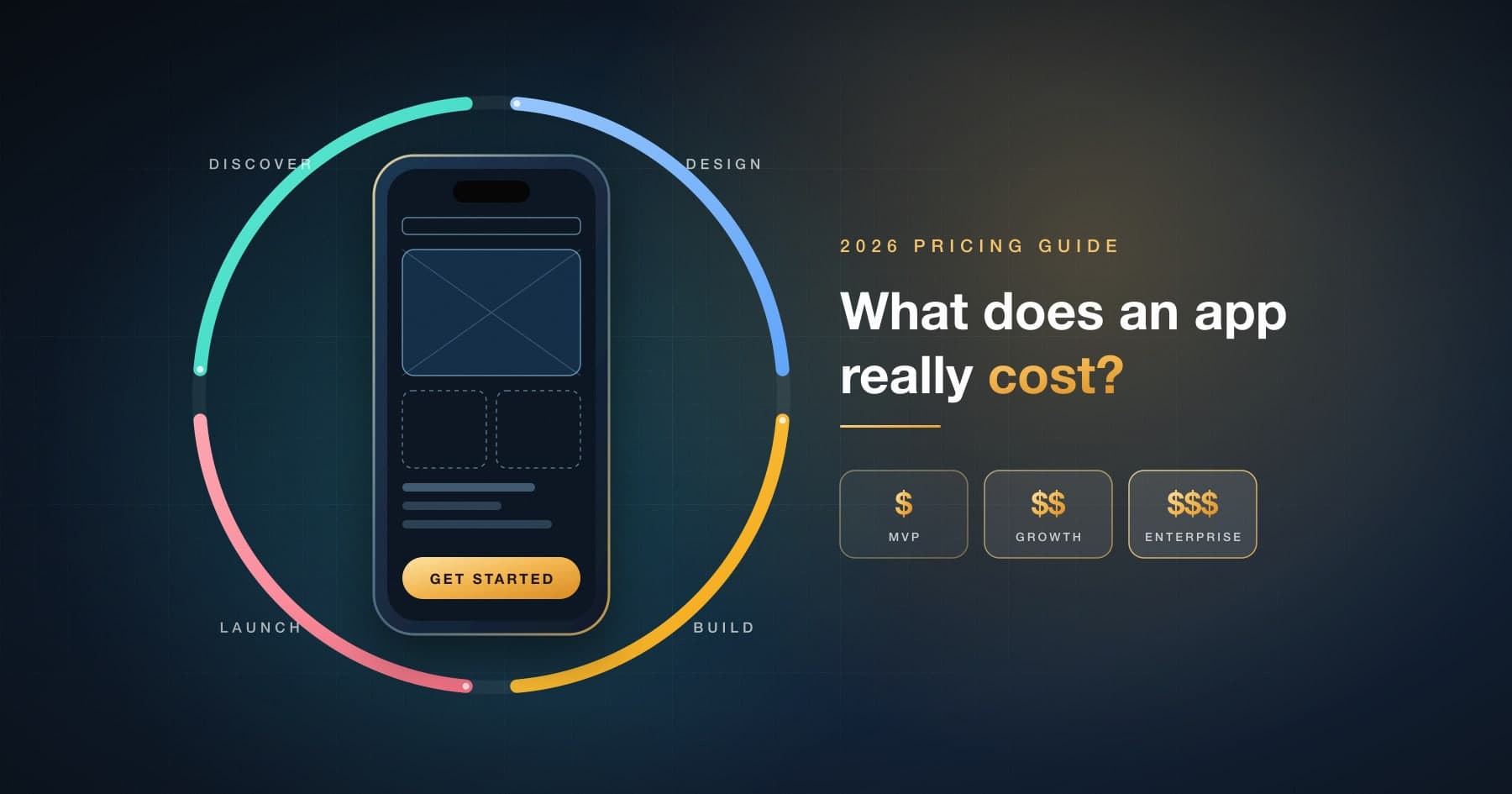
Ask ten development firms what an app costs and nine will say "it depends." They are right, and it helps nobody. You can't take "it depends" to a board meeting, a bank, or a co-founder.
So here are real numbers. Clutch, the B2B review platform that tracks thousands of verified development projects, puts the average mobile app project at $90,780 in its September 2026 pricing guide. The most common project size is far lower: $10,000 to $49,999. Clutch's typical project runs about 11 months from kickoff to completion.
The gap between those two figures is the first lesson in app budgeting. A small number of large, complex builds pull the average up, while most projects are smaller. Your app will likely land in one of those two worlds, and knowing which one is the most valuable thing you can learn before you ask for a quote.
We have built and maintained our own apps for more than a decade, including Calc Pro, which has been downloaded more than 30 million times. This guide covers what we have learned about where the money goes, both on the invoice and after it.
The Short Answer
Industry surveys and agency price guides cluster around three tiers. Treat these as orientation, not a quote:
| Tier | What it usually includes | Typical budget | Rough timeline |
|---|---|---|---|
| MVP | One platform or cross-platform, core flows only, simple backend, basic analytics | $10,000–$50,000 | 2–4 months |
| Growth product | User accounts, payments or subscriptions, third-party integrations, admin tools, polished design | $50,000–$150,000 | 4–9 months |
| Complex or enterprise | Multiple user roles, real-time features, heavy integrations, compliance work, custom infrastructure | $150,000 and up; often well beyond | 9 months or more |
If your idea sits at the top of the MVP tier and a firm quotes you $8,000, ask what is missing. If it sits comfortably in the MVP tier and someone quotes $200,000, ask what they are planning to build that you didn't ask for.
What Actually Drives the Price
1. Features, and especially the ones that talk to other systems
Screens are cheap. Integrations are not. Every connection to a payment processor, a map provider, a CRM, a hardware device, or a single sign-on system adds design work, development, error handling, and testing. A feature that looks like one button, such as "pay with Apple Pay" or "sync with Salesforce," often hides weeks of work behind it.
The best way to control cost is to be ruthless about which integrations the first version really needs.
2. Platforms: iOS, Android, web, or all three
Building two fully native apps, one in Swift for iOS and one in Kotlin for Android, means paying for most of the work twice. Cross-platform frameworks such as React Native and Flutter let one team ship to both from a single codebase, and agencies commonly estimate savings of roughly 30 to 40 percent compared with two native builds.
That estimate matches our experience in direction, with a caveat. When we rebuilt Calc Pro on React Native, one TypeScript codebase came to power iPhone, iPad, Android, and a free browser version. But "one codebase" never means zero platform-specific work. PDF export, sharing to Apple Mail, and audio playback each needed native code before they behaved properly. We wrote about that in detail in One Codebase, Every Screen.
Sometimes the right answer is still native. When timing precision and deep operating-system integration are the whole product, as with our Metronome app, native code earns its higher price. For a fuller comparison of the frameworks, see our React Native vs. Flutter guide.
3. Who builds it, and where
Hourly rates vary more than any other factor. FullStack Labs' August 2026 price guide, which aggregates data from Clutch, GoodFirms, Techreviewer, and others, reports these typical ranges:
| Provider type | Typical hourly rate |
|---|---|
| Agencies in India | $25–$75 |
| Agencies in Southeast Asia | $25–$65 |
| Agencies in Latin America | $40–$100 |
| Established freelancers | $75–$150 |
| Boutique and small agencies | $75–$250 |
| Mid-market custom development firms | $100–$300 |
The same guide cites a 2026 Techreviewer survey in which the largest single group of vendors bills $30 to $49 an hour, and about 90 percent bill under $100.
The arithmetic is simple and sobering. Take a hypothetical MVP that needs 1,000 hours of design, development, and testing. At $50 an hour it costs $50,000. At $150 an hour it costs $150,000. The scope is identical. What changes is the rate and, ideally, what that rate buys you: seniority, communication, time-zone overlap, and accountability when something breaks at 2 a.m.
A low rate isn't always a bargain. A team that takes twice as long, or builds something you must rewrite in a year, costs more than the invoice suggests.
4. Design ambition
A clean app built from standard platform components costs far less than one with custom illustration, bespoke animation, and a unique visual language. Both can be excellent products. Decide which one your market actually rewards before you pay for it.
5. The backend nobody sees
Most apps need more than the app. There are servers, databases, APIs, admin dashboards, push notification services, and the security work that protects all of it. In many projects the invisible half is the bigger half. If a quote only describes screens, ask who is building everything behind them.
6. Compliance and accessibility
Health data, financial data, and children's data all carry regulatory obligations that add design, development, and legal review. Accessibility is also no longer optional in many markets. The European Accessibility Act began applying to a range of digital products and services in June 2025. Building support for screen readers and larger text sizes from the start is much cheaper than retrofitting it later.
The Costs Most Quotes Leave Out
The build is only the down payment. Here is what arrives after launch.
Developer accounts. Apple charges $99 per year for its Developer Program, which is required to publish on the App Store. Google Play charges a one-time $25 registration fee. These are small, but make sure the accounts are registered to your company, not to your contractor.
Store commissions. If you sell digital goods or subscriptions inside your app, the stores take a share. Apple's standard commission is 30 percent, reduced to 15 percent for developers earning under $1 million a year through its Small Business Program. Google Play charges 15 percent on a developer's first $1 million in annual earnings.
The rules are also in flux. In the United States, an April 2025 court ruling in Epic v. Apple stopped Apple from charging any commission when apps link customers to outside payment pages. In August 2026, Apple asked the court to allow fees of up to 15 percent on those purchases, or 5 percent for small businesses, and the Supreme Court is expected to hear arguments in the case in October. If your business model depends on in-app payments, build some uncertainty into your forecast.
Maintenance. A widely used industry rule of thumb is to budget 15 to 20 percent of the original build cost every year to keep an app healthy. That can sound high until you look at what changes each year:
- Apple and Google each ship a major operating system release every year, and each one can break something.
- App stores regularly raise their requirements, from privacy disclosures to minimum target versions of the operating system. Apps that don't keep up can be rejected or hidden.
- Frameworks move quickly. React Native shipped three releases between April and August 2026 alone, and version 0.87 raised its minimum toolchain requirements to Node.js 22, Android Gradle Plugin 9, and Kotlin 2.0.
- Servers, third-party services, and security patches don't pause because the app is "finished."
An app that isn't maintained doesn't stay the same. It slowly breaks.
Third-party services. Authentication, analytics, crash reporting, maps, email, and push notifications are often priced by usage, so costs grow with success. AI features deserve special attention here. Every request to a large language model costs money, so an AI feature carries a running cost per active user. That cost has to fit inside what each user pays you. Prices are falling quickly, which we covered in our look at the latest AI models, but they aren't zero.
Getting found. Publishing an app doesn't bring users. App store optimization, a website, content, and paid acquisition all cost time or money. Budget for launch, not just for the build.
Does AI Make Apps Cheaper Now?
Somewhat, and less than some sales pitches suggest.
AI coding assistants are now standard equipment for professional developers, and they genuinely speed up routine implementation work: scaffolding screens, writing tests, and translating code between languages. What they do not compress nearly as much is everything around the typing. That includes deciding what to build, designing how it should feel, testing on real devices, getting through App Store review, and maintaining the result.
Our view is that AI tools are lowering the cost of the middle of a project and doing much less for its beginning and end. If someone promises your app for a tenth of the usual price "because of AI," ask exactly which phase got cheaper and who is accountable for the quality of what the AI wrote.
How to Spend Less Without Building Worse
Build the smallest version that proves the idea. An MVP should test your riskiest assumption with real users. It shouldn't be a stripped-down version of everything you eventually want. Cut features, not quality.
Pay for discovery first. A short, fixed-price discovery phase covering requirements, user flows, and a clickable prototype costs a fraction of the build. It often saves many times its cost by catching bad assumptions before anyone writes code.
Choose the platform strategy for your product, not for fashion. Cross-platform is the sensible default for most business apps. Native is worth its premium when the product depends on hardware, audio, graphics, or the newest operating-system features.
Plan for maintenance from day one. Put the annual 15 to 20 percent in your financial model now, so it doesn't arrive as a surprise later.
Own everything. Your source code, your developer accounts, your domains, and your cloud accounts should all belong to your company. It costs nothing to set up correctly and a great deal to untangle later.
Questions to Ask Before You Sign
- What exactly is included, and what is explicitly excluded?
- Who will actually work on my project, and how senior are they?
- Is the backend included, and who hosts and maintains it?
- How do you handle changes to scope, and how are they priced?
- What does testing look like, and on which real devices?
- Who submits the app to the stores and handles rejections?
- What happens after launch, and what does a maintenance plan cost?
- Will I own the code, the accounts, and the design files?
A good partner will welcome these questions. A partner who dodges them has answered a different question for you.
The Bottom Line
In 2026, a focused MVP typically costs between $10,000 and $50,000, a growth-stage product between $50,000 and $150,000, and complex platforms considerably more. Clutch's data suggests most projects are smaller than the headline average implies. The true cost of an app, though, is the build plus a year of running it: store fees, services, updates, and the steady work of keeping pace with two platforms that change every year.
The cheapest app is the one you only have to build once. Spend your money on clarity at the start, quality in the middle, and maintenance at the end, and you will spend less overall than the team that saved on all three.
Planning an app and want a realistic estimate? At Panoramic Software, we have designed, built, and maintained mobile apps used by millions of people. Tell us about your project and we will give you a straight answer.
Sources
- Clutch: App Development Pricing Guide, September 2026
- FullStack Labs: 2026 Software Development Price Guide
- Apple: App Store Small Business Program
- Google: Play Console service fees
- MacRumors: Apple wants to charge developers up to 15 percent for linking outside the App Store
- React Native: React Native 0.87 release notes
 Calc ProUnlimited
The gold standard for mobile calculation is now available in your browser. Ten professional calculators, zero compromises.